
It’s one of the most common things my team hears. Not just from patients who’ve just completed their cycle, but from women who froze their eggs months or years ago and are now beginning to think about using them. The process doesn’t get spoken about as clearly as it should, so this article is here to fill in the gaps, honestly, and without the jargon.
The first few days: what’s normal after egg collection
Egg collection is a short procedure carried out under sedation, and most patients are home within a few hours. You’ll need someone to bring you back and stay with you for the rest of that day. Sedation means you genuinely can’t drive or make important decisions, not that we think you’d try.
In the days that follow, it’s completely normal to feel:
- Bloated or tender around your abdomen
- Tired, or more emotionally flat than you expected
Most patients take the day after collection off work. By the end of the week, the majority feel back to normal, though everyone’s body responds differently, and there’s no right timeline. Your period will typically return within two weeks, and your cycle usually settles back into its usual pattern shortly after that.
Meanwhile, in the lab
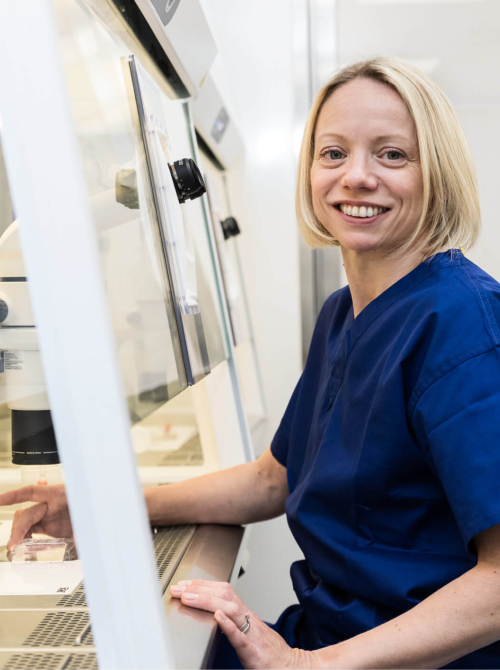
While you’re resting, your eggs are in expert hands.
Our embryologists carefully assess each egg, remove the surrounding cells, and evaluate maturity. Only mature eggs are suitable for vitrification, which is why the number frozen is sometimes slightly lower than the total collected. This isn’t a cause for concern; it’s the process working as it should.
Vitrification is the gold-standard freezing technique. It works by cooling eggs so rapidly to -196°C that ice crystals have no time to form and damage the cells. It’s a significant scientific advance on older slow-freeze methods, and it’s what makes modern egg freezing genuinely reliable.
Once frozen, your eggs can be stored safely in the UK for up to 55 years.
You’ll receive a clear summary of how many eggs were frozen, and your consultant will walk you through what that means for your family-building goals at your follow-up appointment.
What are the chances my eggs will survive being thawed?
This is the question we’re asked most, and it deserves a straight answer.
At The Evewell, our egg thaw survival rate is 95%.
That means when you return to use your eggs, 95 in every 100 frozen at The Evewell are expected to survive the warming process intact and ready to be fertilised.
In practical terms, if you have 10 eggs in storage, you can reasonably expect 9 or 10 to survive thawing.
Not every egg that survives will necessarily fertilise or develop into a viable embryo; that depends on factors including egg quality and the sperm used, but the thawing itself is handled extremely well by modern vitrification.
It’s a figure we’re proud of, because it reflects both the skill of our embryology team and the quality of our laboratory environment.
Do thawed eggs behave the same as fresh ones?
This surprises many patients: yes, they do.
Research consistently shows that vitrified eggs, once warmed, behave in the same way as fresh eggs when it comes to fertilisation and embryo development. The warming process, carried out by an experienced team using validated protocols, doesn’t compromise an egg’s ability to fertilise or develop.
What matters, and what freezing cannot change, is the quality and maturity of the egg at the time it was stored. This is why age at freezing is so significant. Eggs frozen in your late twenties or early thirties carry the chromosomal health of that age, regardless of when you come back to use them.
That is, in essence, the whole point. You are banking the biological quality of today for a future you can’t yet see.
When you’re ready to use your eggs: what the process looks like
Once warmed, the path forward is the same as a standard IVF cycle. The eggs are fertilised, monitored in the lab as embryos develop, and one is transferred to the uterus at the appropriate stage. How you get to fertilisation depends on your circumstances, and you have real options.
With a partner’s sperm
- If you have a partner, when you decide to use your eggs, their sperm can be used to fertilise them.
- Fertilisation is done via ICSI (Intracytoplasmic Sperm Injection) rather than conventional IVF, this is standard practice with frozen eggs, as it produces the best outcomes and accounts for any minor changes to the egg’s outer layer after freezing.
With donor sperm
- Many of our patients freeze their eggs without a partner and go on to use donor sperm when they’re ready. Whether you’re a solo woman by choice, in a same-sex relationship, or simply know this is the right path for you, this is a well-established and widely supported route.
- Our team will guide you through the donor selection process, which is deeply personal, and be with you at every step.
- In the UK, donors are identity-release, meaning any child born has the right to access information about their donor from age 18.
Reciprocal IVF, for same-sex female couples
- One partner’s frozen eggs can be fertilised with donor sperm, and the resulting embryo transferred to the other partner’s uterus. Both partners have a biological connection to the pregnancy, one genetic, one gestational.
- It’s a path we support with care and experience, and one that means a great deal to the families who choose it.
Solo parenthood
- An increasing number of women freeze their eggs as solo women who may want a child on their own in the future.
- When you’re ready, donor sperm is used to fertilise your eggs and the embryo is transferred to your uterus.
- Our team will support you practically, medically, and emotionally, because this journey deserves that full picture.
When should you come back?
Whenever it feels right.
There is no rush, no pressure, and no expiry date looming over you. Your eggs are stored safely and can remain frozen for up to 55 years. The right moment is the one that belongs to your life, whether that’s two years from now or ten.
When you’re ready, get in touch. We’ll arrange a consultation to review your history, talk through your current circumstances and goals, and put together a personalised plan for your embryo transfer cycle.
We’ll also give you a clear picture of your realistic chances, based on your age at the time of freezing and the number of eggs you have stored.
A note from our team
Egg freezing is not just a procedure. It’s a decision that can shape your future in the most meaningful way, and the conversation doesn’t end when you leave the clinic after collection.
Whether you’re just considering it, mid-cycle, or already have eggs stored with us and are beginning to wonder what comes next, our Patient Services team is here. Not with a script, but with genuine answers to your actual questions.
Get in touch to arrange a no-obligation call, and let’s talk about what your next chapter could look like.
Call us on 020 3974 0950 or visit our Support section to find out more.


Find out more








For advice, regular tips and support, connect with us
On Social Media

