
How long is the IVF timeline from start to finish?
A full IVF cycle, from the start of stimulation to the pregnancy test, typically takes around four to six weeks. But the overall IVF timeline is usually longer when you factor in your initial consultation, investigations, and planning appointments.
How long IVF takes will also depend on whether you’re having a fresh or frozen transfer, how your body responds to stimulation, and whether any additional investigations are needed.
Your consultant will give you a personalised timeline once your IVF treatment plan is in place.
What are the main stages of IVF?
There are several distinct stages to an IVF cycle.
At The Evewell, these IVF stages typically include:
• Initial consultation
• Personalised treatment plan
• Nurse and embryologist consultations
• Scanning phase
• Ovarian stimulation
• Trigger shot
• Egg retrieval
• Fertilisation and the lab process
• Embryo transfer
• The two-week wait
• Pregnancy test
Not every cycle looks identical, and your consultant will talk you through what applies to your specific situation. Below, we cover each IVF stage in detail.
1. The initial consultation
The first step of any treatment is the initial consultation, during this first consultation, you will meet your consultant who will be looking after you during your time at The Evewell. The initial consultation is a space to talk about what’s concerning you, what your family planning goals are and any questions you have regarding fertility treatment in general.
Discussing your family planning goals is something really important to consider, as this will help us plan for the future, as well as any immediate treatment.
At this meeting, we’ll go through your medical history including any previous investigations or treatment you have had. If you’ve had treatment in the past, we’ll also discuss this with you. We know that this can be upsetting but it is important that we look at this to understand what went well and what didn’t, so we’re sure we can optimise the cycle of treatment with us.
In a nutshell, this is your time to ask any questions and make sure you leave feeling fully informed and comfortable with the approach for your fertility treatment. You’ll receive a follow-up letter outlining what was discussed, any next steps (such as further investigations) and your treatment recommendations.

2. Your personalised treatment plan
After your Initial Consultation, your consultant will put together a bespoke treatment plan based on your medical history and your preferences for treatment.
Our goal at The Evewell is to help you achieve a successful pregnancy in the least invasive and shortest amount of time. IVF is not our default position. It may be that we can start with much less invasive treatments such as ovulation induction and IUI and this will be all that is needed. However, it may be the case that IVF is the best option based on your medical history and family planning goals.
This may also include more tailored IVF approaches such as Natural or Mild IVF, which use little or no stimulation medication compared with conventional IVF.
Our Fertility Coordinator will contact you, once she has your treatment plan from your consultant, and go through with you the details of the plan and when you were hoping to start. She will then coordinate all your planning meetings to get you ready for your cycle and also send you detailed costings for your treatment.
Once you have the costings, we can organise a time to chat them through with you and answer any questions you may have.
Find out more about our pricing here.
3. Nurse & embryologist consultation
Once you’re happy with your treatment plan and costs, you’ll have two planning appointments before your cycle begins.
Nurse Consultation
This appointment lasts up to 90 minutes, and it’s helpful if your partner can join you if they’re involved in your treatment. Your nurse will go through all of the regulatory consent forms required by the HFEA, page by page, so you’re fully clear on everything at each stage.
You’ll also go through your full protocol in detail: when you’ll need to come in for scans, any procedures involved, and exactly how to take your IVF medications.
Medication is a big focus of this appointment. We know it can feel daunting, and we’ll make sure you leave feeling confident about what you’re taking, when, and how.
Embryologist Consultation
Your second planning appointment is with the embryology team. At The Evewell, our embryologists are an active part of your clinical team, not just scientists working in the background.
This is a chance for them to explain their role in your treatment, walk you through what happens in the lab after egg retrieval, and answer any questions about specific procedures such as ICSI or PGT-A.
You’ll hear from the embryology team at key points throughout your cycle, so this is also a great opportunity to get to know the people who’ll be caring for your embryos.
Find out more about our laboratory here

4. The Scanning Phase
Once you’ve called the nurses to confirm the start of your treatment cycle, you move to the Scanning Phase.
Your first scan is known as the ‘baseline scan’, on day 2 of your period. This is where we check the number of follicles and take a blood test to check your hormone levels.
You’ll then have another scan a few days later to see how your body is responding to the medication, and then you can expect to have scans every 2-3 days to monitor the progress of your follicles.
Blood tests will only be taken if they will add anything to the clinical picture – we don’t want our patients to pay for anything that isn’t needed!
In your average IVF / ICSI cycle, you can expect around 4-5 scans across a two-week period, with the bulk concentrated towards the end of the cycle.
Scans and blood tests are done in the morning, so we get the results back in time for our All Hands consultation in the afternoon (more on this later!)
5. Our All Hands Daily Medical Review Meetings
We have daily All Hands Medical Review Meetings between all clinical teams to review each patient in cycle, so despite having a dedicated doctor, you benefit from the wealth of knowledge of our entire team.
Attended by all consultants, the senior nursing team, senior embryologists and senior members of the patient services team, we use this time to review every patient who has been in that day for scans or blood tests.
We then discuss results, taking into consideration any previous treatments, and adjustments to treatment plans or medication will be made here.
This kind of holistic approach to your fertility treatment means every single patient benefits from all the consultant’s combined knowledge and experience in fertility and gynaecology.
The nurses will then contact you to update you on what to do until your next scan. This may be to carry on, with no change or that we are adjusting your medication. You should never worry – the nursing team don’t leave the building until everyone has been spoken to!
This process is a fantastic tool for both you and us. For us, it means we collaborate and share all our knowledge to optimise treatment for our patients. It also means that communication on your cycle runs smoothly across all teams. For you – you’ll always know that on the day of your scan you will hear from us about how things are going.
Find out more about why you should choose The Evewell here.

6. Ovarian Stimulation
Ovarian stimulation is one of the central stages of the IVF process. During this phase, you’ll take hormone medication, usually via daily injections, to encourage your ovaries to produce multiple follicles rather than the single egg your body would naturally release each month.
The type and dose of medication you take are based on your personalised treatment plan, and your response will be monitored closely throughout via regular scans and blood tests. If your protocol needs adjusting at any point, this happens through the All Hands daily review.
Stimulation typically lasts around 10 to 14 days, though this varies from person to person.
If you’re new to IVF injections, it’s worth knowing that most people find them manageable once they’ve got the first one out of the way. Our nursing team will make sure you feel confident before you begin.
Read our tips for taking IVF medication
Watch our how-to guides on injecting fertility medication
7. Trigger shot
When your follicles have reached the right size, your consultant will confirm the timing of your trigger injection, a hormone injection that triggers the final maturation of your eggs ahead of retrieval.
Timing is precise, so it’s important to take your trigger shot exactly when your team advises. Your egg collection will usually be scheduled for around 36 hours later.
The nursing team will go through the trigger injection instructions with you clearly. If you have any last-minute questions, you can always reach us on the nursing team’s emergency line, which is available seven days a week until midnight.
6. Egg retrieval
Around 11 to 12 days after starting stimulation, your consultant will confirm at the All Hands meeting that you’re ready for egg retrieval. The nursing team will email your instructions and follow up with a call to go through everything with you.
On the day, you’ll arrive at The Evewell and be shown into one of our private rooms, designed to give you space and quiet before the procedure.
The egg retrieval procedure takes around 20 to 30 minutes, and you’ll be under deep sedation throughout, so you won’t be aware of what’s happening and won’t feel any discomfort.
Afterwards, your consultant will confirm how many eggs were collected and talk you through the next steps.
Read our full guide to what happens during egg collection
7. Fertilisation & lab process – when the lab calls, and why they call (or don’t call)
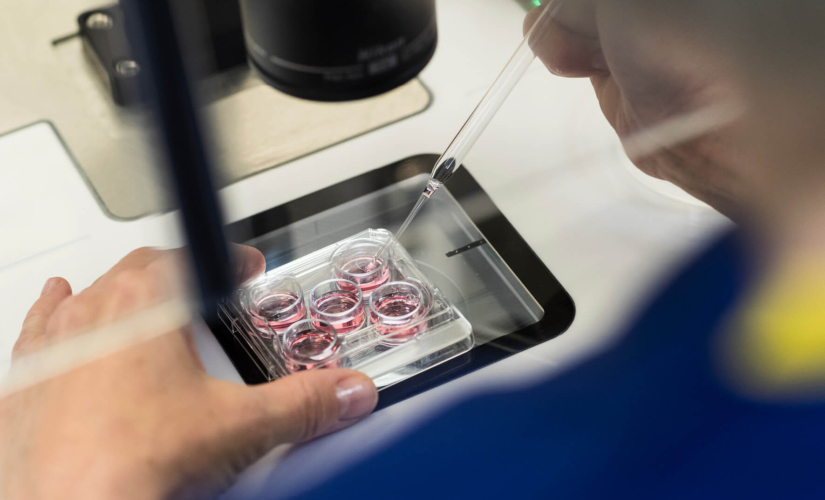
If you’re having standard IVF, the eggs are placed in a dish with the sperm a few hours after retrieval. If you’re having ICSI, a single sperm is injected directly into each mature egg.
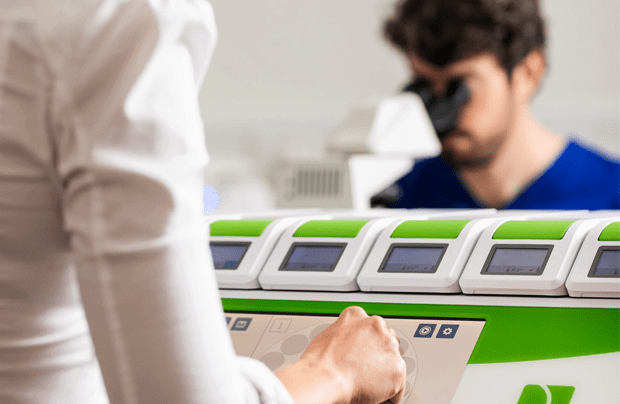
The day after retrieval, you’ll get a call from the embryology team to let you know how many eggs were fertilised. After that, there are usually a few days when you won’t hear from us directly, which can feel strange. But your embryos are being carefully observed in our time-lapse incubators, which use an integrated camera to capture continuous images without disturbing them.
You’ll hear from us again on day five, when the team will talk you through how your embryos have developed and confirm the transfer plan. If you’re having a freeze-all cycle or PGT-A, your update will also come on day five.
9. The Embryo Transfer
After your egg collection, if you’re doing a fresh embryo transfer, you’ll start taking progesterone to prepare your lining, ready to receive an embryo, and a few days later, your embryo will be transferred into your uterus.
Your embryo transfer can be the most emotional stage of the IVF process. And it’s understandable; there is a lot riding on this moment – and it’s also the moment you’re reunited with your precious cargo.
When you arrive for your transfer you’ll be shown into one of our quiet rooms and the embryologist will then update you on the development of your embryos. They will discuss with you the embryo being transferred and potentially, whether any embryos are being frozen.
The procedure is usually no longer than 15 minutes and shouldn’t be painful, although you might experience mild cramping. It isn’t too dissimilar to a smear test. You’ll be able to go home straight after and resume a normal life.
If there is not an embryo to transfer, when you arrive you’ll meet with your consultant and the embryology team. This gives us all an opportunity to meet face to face to discuss what has happened, answer any questions and provide you with support.
If you are having a frozen embryo transfer we have outlined the timeline and what you can expect on our support page here.
10. The Two-Week Wait
Many IVF patients can find the two-week wait the hardest part of the IVF cycle. Self-care and taking it easy during the two-week wait is an important part of the process. Try to schedule some time each day to relax and unwind.
Practising things such as meditation, mindfulness, light exercise, walking or just curling up with Netflix can help during this time to help reduce stress hormones and calm the mind. Anything to help alleviate stress and anxiety, especially as it’s common during this time to wonder about symptoms after embryo transfer and what they might mean. You can also read our full guide on what to do after an embryo transfer, covering medication, activity and rest.
We won’t want to bother you during this time – receiving a call from us can worry patients unnecessarily – but you should not hesitate to reach out to us if we can be of any support.
11. The Pregnancy test
The last part of your IVF cycle is the pregnancy test. Normally patients will want to do a home pregnancy test as soon as possible – we recommend doing this on day 12. Doing it too early may lead to unnecessary upset.
Once you have done your test, do call or email us – we are here to support you whatever the outcome and let you know the next steps. We provide full pregnancy support for patients until they are 12 weeks including blood monitoring and medications. If things haven’t worked out, we will get you booked for a complimentary meeting with your consultant as soon as possible. You will not be left on your own.
12. Counselling
Fertility treatment can be an emotional rollercoaster, so getting support from people who can relate to what you’re going through is very important.
That’s why we offer every patient a complimentary counselling session with every egg collection cycle. There are two types of counselling: supportive counselling and implications counselling.
Counselling provides individuals and couples with an opportunity to discuss their thoughts and feelings and beliefs in a confidential environment to help them see things with more clarity and gain a better understanding of the potential implications of their decisions.
Our counsellor, Gosia Heeley, is a qualified fertility counsellor, accredited by BACP (the British Association for Counselling and Psychotherapy) and BICA (the British Infertility Counselling Association).
Gosia offers face-to-face, telephone and Skype counselling sessions, with face-to-face sessions offered at two locations: The Evewell or in Guildford, Surrey.



Find out more


FAQs
Preparing for IVF involves both the medical side, which your treatment team will guide you through, and looking after your general health and wellbeing in the weeks leading up to your cycle.
Eating a nourishing diet, staying hydrated, reducing alcohol and caffeine, getting enough sleep, and building in time to rest can all support your body during treatment. Stopping smoking and avoiding recreational drugs is also recommended.
Most people find that the injections involved in IVF become less daunting once they’ve done a few.
The egg retrieval procedure is carried out under deep sedation, so you won’t be aware of it. You may need painkillers for a day or so after to manage the period-like cramps.
The embryo transfer is usually straightforward, with possible mild cramping, again, manageable with painkillers, and most people describe it as similar to a smear test.
Our team will prepare you fully for what to expect at each stage, and you’ll always have someone to call if something feels unexpectedly difficult.
The most common side effects during IVF are related to the stimulation medication and can include bloating, breast tenderness, mood changes, and fatigue. These are temporary and your team will monitor you closely throughout.
In some cases, a condition called ovarian hyperstimulation syndrome (OHSS) can develop. This is something your team actively watches for and manages as part of your cycle monitoring.
We measure success by what matters most: healthy babies born. We’re transparent about our success rates and how we report them, because we believe you deserve clear and honest information when making decisions about your care.
Taking IVF medication correctly is one of the most important parts of your treatment, and your nurse will walk you through everything in detail at your Nurse Consultation. Our nursing team is always available if questions come up along the way.
We also have guides and videos to help you at home.
Gentle movement, such as walking, yoga, or swimming (up to just before egg retrieval), is generally fine during IVF. Just make sure you let the instructor know if you’re taking a class.
High-intensity exercise is best avoided during the stimulation phase, as your ovaries will be enlarged and more sensitive than usual.
If in doubt, ask your consultant or nursing team for more guidance.

For advice, regular tips and support, connect with us
On Social Media

